wall catio
A catio for the cat flap that opens onto nothing
Your cat waits at the patio door, or its flap leads to a step with nowhere to go. A wall catio can start right at that opening. Tell us where the door or flap is, and a builder near you comes to measure and write up a quote.
Have the space measured and quoted first, with nothing to sign.
What we do
We line up an independent catio builder near you who comes to your home, measures the space and gives you a written quote before any deposit.
The measure-first promise
- Asking costs you nothing, and nothing is owed until you book.
- You see a written quote before any deposit is due.
- Your $100 credit is applied exactly as the Terms describe.
- If the introduction goes wrong, tell us and we help put it right.
The builder you hire does the work under your own agreement with them.
SignedCattio Builders, (315) 640-3590
Read the full termsWhat to measure
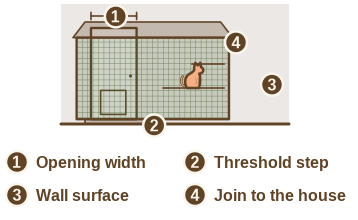
Where the door or flap meets the wall
Mesh and frame
How the mesh stays on
Questions
What to ask before a wall catio goes up
Can a wall catio start at a cat flap?
Yes, it can start there. The builder checks the wall, the step and the space around the flap before saying how it would work.
How big can it be?
That depends on your city and your HOA. Ask your building department about an attached build, and have the builder put the footprint and height on the quote.
Will it damage my wall?
Any fixing leaves a mark. Ask what the structure is fastened into, and what will be left if it is ever removed.
Do I need a permit?
Possibly. It depends on the size, the join to the house and where you live. Ask your building department before you book.
Can I walk inside it?
Some are built with a door sized for you. Others are cat-only. Say which you want when the builder visits.
Does my HOA need to approve it?
If you have an HOA, ask. Your HOA may want plans for anything attached to a wall, and you should have the answer in writing.
Can I use an existing deck or slab?
Sometimes. The builder checks what the deck or slab can carry and where the structure would be held.
Size against the city rule
Your size against your city's rule
Many cities draw a line at a certain size. Measure your footprint and height, then ask your building department how its line treats your design, including any part joined to your house.
| City | What it covers | Size |
|---|---|---|
| SeattleWA | City rule Detached sheds only | 120 sq ft |
| PortlandOR | State code adopted by the city Detached structures only | 200 sq ft |
| San DiegoCA | City rule Detached sheds on the ground only | 120 sq ft |
| DenverCO | City rule Detached sheds only | 200 sq ft and 14 ft high |
| PhoenixAZ | City rule Detached structures only | 200 sq ft |
| AustinTX | City rule Detached structures only | 200 sq ft and 15 ft high |
| MinneapolisMN | State code adopted by the city Detached sheds only | 200 sq ft |
| AtlantaGA | Ask the city: no size rule is on file | Ask the city |
Detached structures only. Attached builds: ask the city.
Attached or apart
Does your catio touch the house?
The versions
The versions of a wall catio
- Off a cat flap
A short enclosure begins at the flap, so your cat steps from the house into mesh.
- Off a patio door
A larger structure starts at the door, with room for you to walk in, plus shelves and a seat for your cat.
- Over a deck or slab
The structure sits on an existing slab or deck. Ask whether it can carry the weight and where it must be fixed.
What your cat does
Signs a wall catio is your build
It waits at the door
Your cat sits by the patio door at the hours you open it, and bolts for the gap.
A flap goes nowhere
You have a cat flap, but the other side is a step, a fence or a yard you do not want it in.
You want room for both of you
You picture sitting inside the structure with your cat, not only looking at it.
A slab or deck is there
A patio or a deck already sits at the back door. It could carry the structure if the builder agrees.
Your back wall is plain
Brick, siding or stucco gives the builder something to fix to, if the rules and your HOA allow it.
The written quote
What the written quote lists for a wall catio
How it joins the house
The quote says where the structure meets your wall, and what it is fastened into.
Size and height
It lists the footprint and height as numbers, so you can put them to your building department.
Frame and mesh
It names the frame material, the mesh and how every panel is held.
The door for you
It states where you walk in, and how that door latches.
The permit question
It names who applies for any permit, you or the builder.
Landlord or HOA
Ask your HOA or landlord first
Order of work
A wall catio visit, step by step
Show us the opening
Take a photo of the door or flap and the wall around it, to show the builder at the visit.
Size it on paper
Note the footprint and height you picture, and ask your building department how it treats a catio joined to your house.
The builder visits
They measure the wall, the step and the ground, then write the quote.
Book if it fits
Pay the deposit through us once the quote suits you and the department has answered.
Start with the opening your cat uses
Watch where your cat goes when a door is open. That spot is the start of a wall catio. It sets where the structure meets the house, how wide the opening is and what your cat steps onto.
Measure the opening, then look at the step below it. A gap between the floor and the ground matters to a small cat, and the builder will want to solve it.
Keep a photo of the door or flap with the wall beside it for the visit. The builder can look at the surface, the lights and any vents before the visit, so you spend the visit on choices.
Tell the builder what you have seen your cat do at that door, and which way it heads once it is outside.
Size changes the permit question
A small attached structure and a large one can be treated differently. Footprint, height and the join to your house all feed into the answer, and each city sets its own line.
The model code lists some detached accessory structures as needing no permit, and the exemptions we hold are written for detached structures. A wall catio is fixed to your house, so ask your building department whether they apply to it.
Picture your footprint in feet, length times width, and the height. Ask the builder to write both on the quote, then ask who pulls any permit.
If you are not sure which rule applies, say so at the visit. A builder who works in your area may know how your building department treats attached structures. Ask them, then confirm with the department yourself.
Next to this build
Other ways out
Window box
On the sill, watching the yard
A mesh box at the window your cat already uses.
See window box catioYard enclosure
At the glass, eyeing the grass
A yard enclosure, with or without a tunnel.
See yard catioPorch or balcony
At the balcony door, crying to go out
Mesh around the porch or balcony you already have.
See porch or balcony catio
Where the structure meets your house
This is the part to ask about most. A wall catio touches your home. Brick, siding and stucco each need a different way of fixing, and each leaves a different mark if it is ever taken down.
Ask what the structure is fastened into and how rain is kept from running behind the join. Ask what will be left on the wall afterward. If you rent, ask your landlord first, in writing.
The builder can answer all of this at the visit. Write each answer beside the quote line it belongs to.
Ask too about the ground under the structure. A slab, a deck and bare soil each need a different base, and the builder can say which fits your yard.
If your HOA checks the back of the house
Your HOA may want to see plans before anything goes on a back wall. Read your covenants for words on structures, additions or exterior changes. Then ask, and keep the reply.
Once you have a drawing from the builder, send it to the HOA with the footprint, the materials and the colors. Ask whether the board wants anything changed. Book only after you have the answer.
What to have ready when the builder visits
The builder walks from your door to the spot, measures the opening, the step, the wall and the ground, and asks how your cat uses the route. They see the details in person that a photo cannot show.
Bring your footprint idea, your photos and any HOA or city notes you have gathered. Say whether you want a door big enough to walk through, and whether more than one cat will use it.
Ask for the written quote to list the frame, the mesh, the fasteners, the roof, the walk-in door, the footprint and height, who pulls any permit, and the deposit and balance. Read it at your own pace before you decide.
Quote factors
What pushes a wall catio quote up or down
How wide and how tall the structure is
What the frame and the roof are made of
Which mesh goes on and how it is fastened
Whether it stands on a slab, a deck or bare ground
How it joins your wall
Doors, shelves and seating for you and your cat
Whether a permit or a plan check is needed
How it runs
How it works
- 01
Tell us the spot
Tell us which window, door or yard spot you picture.
- 02
A builder visits
A local builder visits, measures and writes up a quote.
- 03
Deposit if it suits
Pay the deposit only if the quote suits you.
Where
Wall catio pages by city
Mesh seams
Where a mesh job is won or lost
Guides
More on size, doors and permits
Catio permits
What to measure and who to ask about size
HOA and landlord sign-off
What to read, ask and send before you book
Point us to the door and ask for a visit.