Guide
Your HOA wants plans before anything goes up
Your HOA wants plans first, or your lease says nothing about cats outside, and you need an answer before you pay a deposit. Read the rules, ask in writing and send the builder's drawing. This guide shows what to send and what to do with a no.
Have the space measured and quoted first, with nothing to sign.
What we do
We line up an independent catio builder near you who comes to your home, measures the space and gives you a written quote before any deposit.
The measure-first promise
- Asking costs you nothing, and nothing is owed until you book.
- You see a written quote before any deposit is due.
- Your $100 credit is applied exactly as the Terms describe.
- If the introduction goes wrong, tell us and we help put it right.
The builder you hire does the work under your own agreement with them.
SignedCattio Builders, (315) 640-3590
Read the full termsFind out who says yes
A catio can touch three kinds of rule: your lease, your HOA's covenants and your city. Each has its own owner. Work out which ones apply to you before you spend anything.
The Foundation for Community Association Research counts nearly one in four Americans as living in a community association. If you own a house in a planned neighborhood or a unit in a building, an HOA may be in the picture even if you have never heard from it.
Renting? Your landlord is the first person to ask. If you own and have an HOA, the board or its architectural committee is. If you own and have neither, your city is the one to ask.
Your options
The four ways out
Window box
On the sill, watching the yard
A mesh box at the window your cat already uses.
See window box catioWall off a door
At the door or flap to the patio
A structure that starts at your door or cat flap.
See wall catioYard enclosure
At the glass, eyeing the grass
A yard enclosure, with or without a tunnel.
See yard catioPorch or balcony
At the balcony door, crying to go out
Mesh around the porch or balcony you already have.
See porch or balcony catio
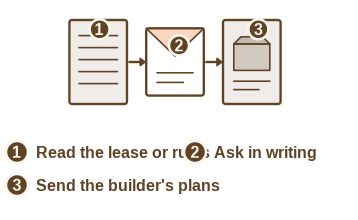
Step one: read the lease or the rules
Look for words on fences, structures, additions, awnings, railings, drilling and exterior changes. Some documents mention pets or animals as well. Note the section numbers.
If you cannot find your covenants, ask your management company or board for a copy. Read what it says about a back wall, a deck or a balcony, depending on the catio you picture.
Write down the lines that matter. You will quote them in your message, which makes it shorter and clearer.
Before the deposit
Ask your HOA or landlord first
Do this before you pay a deposit. A no after you have booked is the hard kind.
Step two: ask in writing, before you pay
Send an email or a letter. Say who you are, which address, what you picture and why. Keep it short.
- Say which opening your cat uses: the window, the door or flap, the yard or the balcony.
- Describe the catio in a sentence, such as a mesh box on the sill or a mesh structure off the back door.
- Ask whether it is allowed, and what the process is.
- Ask for the answer in writing.
Do this before a deposit changes hands. A no after you have booked is much harder to sort out than a no before.
Step three: send the builder's plans
An architectural committee may want to see what will be built. Ask the builder for a drawing once you have a quote. Then send the HOA what it asks for, which often includes the following.
- A drawing or sketch showing where it goes.
- The footprint and height.
- The materials and the colors.
- A photo of the spot as it is now.
Ask the committee what else it wants. Different boards ask for different things, and a complete package saves you a second round.
If you rent
Your lease is the rule. If it says nothing about structures or drilling, you still need your landlord's consent, in writing, before anything is fastened to the building. A phone call is not enough, since it is easy to forget or dispute.
Ask the builder whether a plan can be held without drilling, and what each option leaves behind. Pass that answer to your landlord with a photo. A landlord who sees exactly what is proposed has less to worry about.
Keep the written reply with your quote and your lease. If you move, it shows what was agreed.
Mesh and frame
How the mesh stays on
If the answer is no
Ask what would make it a yes. A smaller footprint, a different color, a spot out of sight or a different type of catio may change the answer. A window box may be fine where a wall catio is not.
In Texas, the Property Code requires an owners' association with more than 40 lots to give a written denial of a plan that describes the reasons in reasonable detail and lists any changes needed for approval. An owner may also ask the board for a hearing on a denied plan. That is a Texas rule, so ask whether anything similar applies where you live.
Whatever the state, ask for the denial in writing and read the reasons. They tell you what to change.
What not to do
- Do not start before you have the answer.
- Do not rely on a verbal yes from a neighbor or a manager.
- Do not send plans you have not read yourself.
These three habits save the most trouble.
Who owns the space
In a building, a balcony may belong to your unit or to the common property. A porch may be yours, shared or leased from the owner. The answer decides who you ask.
Look at your deed, your lease or your covenants, or ask your management company. Say in your message which space you mean. If the owner is unclear, ask for that to be settled first. It saves you a second round of questions.
A message you can adapt
Short messages get answered. Here is a shape to follow, with your own details in place of the brackets.
Hello, I live at [your address] and would like to add a mesh enclosure so my cat can sit outside. It would be [a box at the kitchen window, a structure off the back door, a section of the balcony]. Could you tell me whether this is allowed, and what you need from me? I can send a drawing and the materials once I have a quote from an independent builder. Thank you, [your name].
Send the same message to your landlord, your management company or your HOA board, whichever applies. Keep a copy.
Timing and follow-up
Boards meet on their own schedule, and landlords answer when they answer. Ask when you can expect a reply, and put the date in your calendar.
If you hear nothing, write again and refer to your first message. A short, polite second note often moves things along. Do not book the job on silence.
Your next step
Write the message today, even before you have a quote. Then send us the spot, and a builder can draw up plans for you to share.
After reading
The builds this guide leads to
Porch and Balcony Catios
Mesh around the porch or balcony you already have
Wall Catios off a Door, Flap or Window
A structure that starts at your door or cat flap
Send your spot and get plans ready for the HOA.