Guide
What does your cat actually do all day?
Before you pick a window, a door or a yard spot, watch your cat for a day. Note where it sits, what it watches and when it asks to go out. This guide turns those notes into questions for the builder, so the plan fits the cat you have.
Have the space measured and quoted first, with nothing to sign.
What we do
We line up an independent catio builder near you who comes to your home, measures the space and gives you a written quote before any deposit.
The measure-first promise
- Asking costs you nothing, and nothing is owed until you book.
- You see a written quote before any deposit is due.
- Your $100 credit is applied exactly as the Terms describe.
- If the introduction goes wrong, tell us and we help put it right.
The builder you hire does the work under your own agreement with them.
SignedCattio Builders, (315) 640-3590
Read the full termsWatch before you plan
Your cat has already told you where it wants to be. It sits at one window, waits at one door or paces one stretch of glass. That spot is where a catio starts.
For a day or two, jot down what you see. Where does it sit? What does it watch? At what times does it ask to go out? Does it use a flap, or wait for you? Does a second cat share the spot?
Take the notes to the builder's visit. They tell the builder more than any form can.
Controlled outdoor access has several shapes
Cat-health veterinarians count three routes to controlled time outside: an enclosure, a cat-safe fence, or a harness and leash (Feline Veterinary Medical Association, 2024). American Bird Conservancy names catios among the ways to let an indoor cat explore outside while contained, along with strollers, leashes and backpacks.
A catio is one of several choices. If your cat is happy on a harness, a catio may be a supplement and not a replacement. If your cat hates a harness, it may be the only option. Think about which suits your cat.
The four ways out
Start at the way out your cat already uses
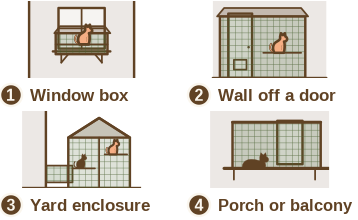
Your cat has already picked a spot. Find yours below and open it to see what that build asks of you.
Window box
On the sill, watching the yard
A mesh box at the window your cat already uses.
See window box catioWall off a door
At the door or flap to the patio
A structure that starts at your door or cat flap.
See wall catioYard enclosure
At the glass, eyeing the grass
A yard enclosure, with or without a tunnel.
See yard catioPorch or balcony
At the balcony door, crying to go out
Mesh around the porch or balcony you already have.
See porch or balcony catio
Plan the way in and out
Think about how your cat gets from the house to the catio. A window box can use the window. A wall catio can use a flap or a door. A yard catio can use a tunnel or a door you carry your cat through.
Humane World for Animals suggests placing a catio where you can see it from your home, fitting a human-sized door, and adding lights if your cat will have nighttime access. Ask the builder how your plan covers each.
Tell the builder if you have more than one cat, or if one cat chases another. Two cats may need two perches, two exits or a wider route.
Shade, air, water and shelter
Humane World for Animals says a catio needs ventilation in warm weather, a sheltered spot out of the cold, rain and sun, and fresh water, especially on warm days. Each one is a question for your plan.
- Where does the sun land in the afternoon, and is there shade?
- Where does your cat go when it rains?
- Where does the water bowl sit, and who refills it?
- How does air move through the space in summer?
Cities differ here. Our city pages hold the weather we have sourced for eight cities, and the permit rules for each.
Roof, snow and winter
The same group says a catio roof should be strong enough for whatever snowfall your area gets. If you live where snow falls, ask what the roof is built to carry. If you live where it does not, ask what the roof does for sun and rain instead.
Plants and what grows nearby
Some plants are a problem for cats. The ASPCA plant list names the Easter lily, tiger lily and Asiatic lily among the plants toxic to cats. If you plan to add planters to the catio, check the ASPCA list before you buy anything. If your yard already has any of these, tell the builder, and think about where the mesh sits in relation to them.
We do not sell or recommend plants, so check the list yourself.
See what others have done
In Portland, Oregon, the Catio Tour is a self-guided tour of cat enclosures run by the Feral Cat Coalition of Oregon and Bird Alliance of Oregon. Seeing a few in person shows you how people handled doors, shelves and roofs.
Elsewhere, ask the builder whether you can see photos of work they have done, and ask them to explain what you see.
Indoors and out, together
Austin's parks department says keeping cats indoors is better for cats and for wildlife, and suggests a protected catio for outdoor time. Oregon's fish and wildlife department advises keeping cats indoors or using a secure outdoor enclosure called a catio.
Plan the route back inside as carefully as the way out.
What to photograph and bring
Take a photo of the spot your cat uses most, from your cat's height if you can. Take one of the space outside, and one of the way between them. Note what you see in your cat's day.
Bring the photos and your notes to the visit. Add the rough size you picture and any lease or HOA lines. A builder who has seen these on arrival can spend the visit on choices, not questions.
Your own use of the space
You will go in to clean, to refill the water and to collect your cat. Think about how you want to do that. Do you want to stand inside, or reach in from a door? Do you want a seat?
Tell the builder which you want.
Your next step
Pick the opening your cat uses most, and send us the spot. Add your notes when the builder visits, and ask how each one is handled in the plan.
After reading
The builds this guide leads to
Window Box Catios
A mesh box at the window your cat already uses
Freestanding Yard Catios
A yard enclosure, with or without a tunnel
Tell us your cat's favorite spot and ask for a visit.