Guide
How do you know the mesh will hold?
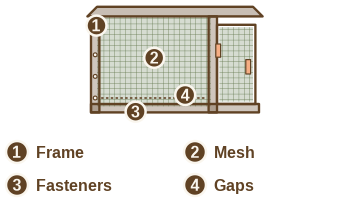
You cannot judge mesh from a photo, and you do not need to. You can ask six questions and get the answers in writing. This guide covers the frame, the mesh, the fasteners, the gaps, the door and the roof, using what welfare groups and wildlife agencies say.
Have the space measured and quoted first, with nothing to sign.
What we do
We line up an independent catio builder near you who comes to your home, measures the space and gives you a written quote before any deposit.
The measure-first promise
- Asking costs you nothing, and nothing is owed until you book.
- You see a written quote before any deposit is due.
- Your $100 credit is applied exactly as the Terms describe.
- If the introduction goes wrong, tell us and we help put it right.
The builder you hire does the work under your own agreement with them.
SignedCattio Builders, (315) 640-3590
Read the full termsWhat this guide does and does not do
We do not build catios, and we do not recommend a mesh, a gauge or a fastener. We hold no source that names one, so we will not. The independent builder names theirs, and you check that the answer is written on the quote.
What we can pass on is what welfare groups and wildlife agencies say about enclosures. Use it as a list of questions, not as a specification.
Why an enclosure at all
The Feline Veterinary Medical Association's 2024 position statement names an outdoor enclosure, a cat-safe fence, or a harness and leash as controlled outdoor access. American Bird Conservancy lists catios, strollers, leashes and backpacks as ways to let an indoor cat explore outside while contained.
If you picture your cat outside, an enclosure is one of the ways those groups name. The rest of this guide is about making the one you choose hold together.
Your options
The four ways out
Window box
On the sill, watching the yard
A mesh box at the window your cat already uses.
See window box catioWall off a door
At the door or flap to the patio
A structure that starts at your door or cat flap.
See wall catioYard enclosure
At the glass, eyeing the grass
A yard enclosure, with or without a tunnel.
See yard catioPorch or balcony
At the balcony door, crying to go out
Mesh around the porch or balcony you already have.
See porch or balcony catio
Mesh and frame
How the mesh stays on
The frame
Ask what the frame is made of and why. Humane World for Animals suggests wood or metal, both sturdy and nontoxic, and nothing that could snag a cat's collar.
Ask how the frame meets your house, your fence or the ground. A frame that wobbles at the join is a place for the mesh to pull loose. Ask what holds the frame down, and what it rests on.
The mesh
Ask which mesh the builder uses and how big its openings are. Humane World for Animals says a catio should have no openings a cat could squeeze through, even on top, because cats climb well and some dig.
That sentence does two jobs for you. It tells you to check the roof as well as the walls, and it tells you to ask about the base. A cat that digs finds the bottom edge. Ask what the base is and what it does where the frame meets the ground.
The fasteners
Ask what holds the mesh to the frame and how often. Ask about the corners and the edges. Ask what happens at a seam where two sheets meet.
You are not looking for a technical answer. You are looking for an answer that is specific. A builder who names the fastener and how far apart it sits has answered. One who says it is all fine has not told you anything.
The gaps
Walk around the plan and look at every place where two parts meet. The top of a wall and the roof. The door and its frame. The edge of the mesh and the house wall. A gap there is the one your cat will find.
Ask the builder to point to each joint on the drawing and say how it is closed. Ask for that to be on the quote, or on a sketch attached to it.
Mesh seams
Where a mesh job is won or lost
The door
Ask how the door latches and whether your cat can work the latch. Humane World for Animals suggests fitting a human-sized door, so that you can get in to clean and to fetch your cat. If your cat is nimble, ask whether the door opens into a small space where it cannot dart past you.
The roof
Ask what covers the top and how it handles weather. Humane World for Animals says a catio roof should be strong enough for whatever snowfall your area gets, and that a catio needs ventilation in warm weather, a sheltered spot out of the cold, rain and sun, and fresh water.
If you live somewhere with heavy snow, ask what the roof is built to carry. If you live somewhere hot, ask where the shade is and how air moves through. Our city pages carry the weather we hold for each city.
Wildlife outside the mesh
Oregon's fish and wildlife department advises keeping cats indoors, and also names a secure outdoor enclosure called a catio. It says coyotes live in many large U.S. cities, including Portland.
If wildlife is a worry where you live, tell the builder what you have seen. Ask what the mesh, the fasteners and the base do about it, and ask for the answer in writing. We do not call any build proof against an animal.
The six questions in one list
- What is the frame made of, and what does it rest on?
- Which mesh is used, and how big are its openings?
- What holds the mesh, and how often?
- Where are the gaps, and how is each one closed?
- How does the door latch?
- What covers the top, and what does it do in your weather?
Your next step
Print the six questions or save them to your phone. Take them to the visit and ask each one aloud. Then check the quote for the answers before you pay a deposit.
After reading
The builds this guide leads to
Window Box Catios
A mesh box at the window your cat already uses
Freestanding Yard Catios
A yard enclosure, with or without a tunnel
Take the six questions along and ask for a visit.