yard catio
A yard catio for a cat that watches through glass
Your cat eyes the lawn through the glass all day, and you will not let it roam. A yard catio stands apart from the house, with or without a tunnel to a door. Tell us the spot, and a builder near you comes to measure and write up a quote.
Have the space measured and quoted first, with nothing to sign.
What we do
We line up an independent catio builder near you who comes to your home, measures the space and gives you a written quote before any deposit.
The measure-first promise
- Asking costs you nothing, and nothing is owed until you book.
- You see a written quote before any deposit is due.
- Your $100 credit is applied exactly as the Terms describe.
- If the introduction goes wrong, tell us and we help put it right.
The builder you hire does the work under your own agreement with them.
SignedCattio Builders, (315) 640-3590
Read the full termsWhat to measure
What the yard route needs
Landlord or HOA
Ask your HOA or landlord first
Questions
What to ask before a yard catio goes up
Does a yard catio need a tunnel?
No. A tunnel is optional. Without one you take your cat out through your own door, and with one your cat comes and goes along a mesh route.
How big can a yard catio be?
That depends on your city and your HOA. Ask your building department how it treats your design, and have the builder put the footprint and height on the quote.
Does it need a permit?
Possibly. Some cities set a size line for detached structures. Ask your building department before you book.
Can it go on lawn?
Sometimes, but the builder decides after seeing the ground. Ask how the base is held down and how it is kept level.
What about coyotes or hawks?
Tell the builder what you have seen. Ask what the mesh, the fastening and the roof do about it, and ask for the answer on the quote.
Can two cats share one?
It depends on the room. Say how many cats you have, and ask the builder for shelves and corners for each.
Who builds it?
An independent builder near you does, under your agreement with them. We look for a builder who can visit the yard and write up the quote.
Size against the city rule
Your size against your city's rule
Many cities draw a line at a certain size.
| City | What it covers | Size |
|---|---|---|
| SeattleWA | City rule Detached sheds only | 120 sq ft |
| PortlandOR | State code adopted by the city Detached structures only | 200 sq ft |
| San DiegoCA | City rule Detached sheds on the ground only | 120 sq ft |
| DenverCO | City rule Detached sheds only | 200 sq ft and 14 ft high |
| PhoenixAZ | City rule Detached structures only | 200 sq ft |
| AustinTX | City rule Detached structures only | 200 sq ft and 15 ft high |
| MinneapolisMN | State code adopted by the city Detached sheds only | 200 sq ft |
| AtlantaGA | Ask the city: no size rule is on file | Ask the city |
Detached structures only. Attached builds: ask the city.
Attached or apart
Does your catio touch the house?
The versions
The versions of a yard catio
- Standing alone
An enclosure sits in the yard on its own. You carry or walk your cat out to it through your own door.
- With a tunnel
A mesh tunnel links a door or window to the enclosure. Your cat comes and goes by itself, along a route you can see.
- Tall and tiered
A taller structure adds levels for climbing. Ask how height affects your city's size rule and your HOA.
What your cat does
Signs a yard catio is your build
It stares at the grass
Your cat pins itself to the glass door that faces the lawn.
It slips out when it can
Every opened door becomes a dash, and you do not want it loose in the yard.
You have space to spare
A corner, a side yard or a patch near the fence is not being used.
Two cats, different moods
One wants to climb and one wants to nap. A bigger footprint gives each its own corner.
You just moved somewhere wilder
The new neighborhood has wildlife you did not see before. Ask the builder what the mesh and the base do about it.
Mesh and frame
How the mesh stays on
The written quote
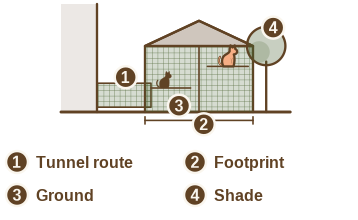
What the written quote lists for a yard catio
Footprint and height
The quote lists both as numbers, so you can put them to your building department.
The ground and the base
It says how the frame stands on lawn, soil or paving, and how it is held down.
Mesh, frame and fastening
It names each, so you can compare quotes side by side.
The tunnel, if you want one
It states the route, the length and where it meets your house.
Roof, shade and door
It covers what is overhead, where the sun falls and how you get inside.
Order of work
A yard catio visit, step by step
Pick the spot
Choose a patch of yard your cat can reach, and photograph it.
Ask about the size
Note the footprint and height you picture, and ask your building department how it treats a tunnel to your house.
The builder visits
They walk the yard, check the ground and write the quote.
Book if it suits
Book with a deposit through us when the quote suits you and the department has replied.
Choose the spot your cat can reach
A yard catio only works if your cat reaches it. Pick a patch near a door or a window you can open, and think about the route. A short, clear route beats a long one.
Look at the ground. Flat lawn, bare soil and paving each ask for a different base. Look up as well, since branches, wires and eaves above the spot change what roof or shade the builder suggests.
Photograph the spot from the door, then again from the far side. Send both so the builder arrives knowing the layout.
Tell the builder which side your cat likes to face, so the perch goes toward the view.
Next to this build
Other ways out
Window box
On the sill, watching the yard
A mesh box at the window your cat already uses.
See window box catioWall off a door
At the door or flap to the patio
A structure that starts at your door or cat flap.
See wall catioPorch or balcony
At the balcony door, crying to go out
Mesh around the porch or balcony you already have.
See porch or balcony catio
How big is too big for your yard?
A freestanding structure may be treated like an accessory building, and cities draw their own lines on footprint and height. The suburbs around a city set theirs.
Pace out the footprint you picture, in feet. Then phone your building department and ask what applies to a detached structure of that size, and whether a tunnel changes it.
If you are close to the line, ask the builder what a slightly smaller plan would look like. Write the answer on the quote beside the footprint.
Remember the lot itself. Fences, setbacks and easements can limit where a structure may stand, even when the size is fine. Ask your city or HOA about the spot you picked, and tell the builder what you hear.
Do you want a tunnel, and where would it run?
A tunnel lets your cat visit the yard without you opening a door. It also adds a route that must be fastened to the house and held off the ground. Ask where it would meet your wall and what that leaves behind.
Think about who uses the route. If you have more than one cat, ask how the tunnel is sized and whether cats can pass each other. If you do not want a tunnel, say so, and the builder will plan a door you carry your cat through.
Ask what the tunnel is fastened to at each end and how it is kept off the ground. Ask whether you can reach inside it. A tunnel you cannot reach is a problem on the day your cat will not come out.
Sun, shade and what lives nearby
A yard enclosure sits in the open. Ask the builder where the sun falls through the day and what shades your cat in the afternoon. Humane World for Animals says a catio needs a sheltered spot out of the cold, rain and sun, plus fresh water, and a roof that can handle your area's snow.
Wildlife advice comes from your own state. In Oregon, for example, the fish and wildlife department advises keeping cats indoors or using a secure outdoor enclosure called a catio. Ask your state's wildlife agency what it says for your area. Then tell the builder what you have seen near your yard, and ask what the mesh, the fastening and the base do about it.
Ask for the answer on the quote. If your city has a page here, it lists the local weather and wildlife notes.
Last, picture the enclosure in summer and in winter, and ask where the shade moves.
Mesh seams
Where a mesh job is won or lost
Walking the yard with the builder
The builder comes to your home. Ask them to walk the yard with you and to look at the spot, the ground, the route from the door and what hangs overhead. Tell them how many cats you have and how each one behaves.
Have your photos and your pace-out numbers ready, plus any HOA or city notes. Say whether you want a tunnel, and whether you want a door sized for you.
When the written quote arrives, read it against the checklist on this page. Ask the builder to explain any line you cannot match to what you saw in your yard, and pay a deposit through us only if the quote suits you.
Quote factors
What pushes a yard catio quote up or down
How much ground the footprint covers and how tall it stands
How easy the spot is to reach with materials and tools
What the ground is like where the frame must stand
Whether your city or HOA asks for plans before work starts
How it runs
How it works
- 01
Tell us the spot
Tell us which window, door or yard spot you picture.
- 02
A builder visits
A local builder visits, measures and writes up a quote.
- 03
Deposit if it suits
Pay the deposit only if the quote suits you.
Where
Yard catio pages by city
Guides
More on size, tunnels and permits
Catio permits
What to measure and who to ask about size
Mesh and framing
Six parts to ask a builder about
Pick your patch of yard and ask for a visit.